


Choosing the right squeegee
RKS Rotary Screen Squeegee type RS
DO NOT SETTLE FOR LESS
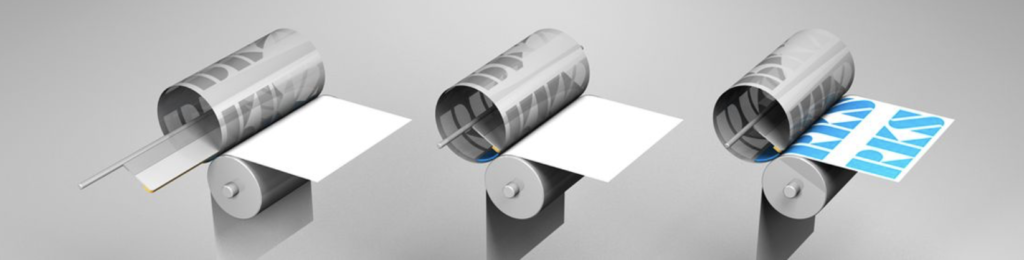
RKS Rotary Screen Squeegee type RS
The RKS rotary screen squeegee type RS is a highly flexible squeegee blade, additionally sturdy enough to meet required print parameters. Thus, the required parameters such as squeegee angle, parallel and pressure can still be set without taking any form or memory during or after use of the squeegee.
While it is printing results that matters
As an illustration, the design of a RKS rotary screen squeegee RS will improve your printing efficiency. In contrast to the commonly used standard stainless steel blade, the RKS RS will enable a substantial higher printing speed (up to 15% increase), with no compromise to the desired printing quality.
A squeegee that last long
Additionally, the insoluble bond between the career and the elastic print edge is a unique innovation by RKS. Consequently the squeegee provides you a longer lifetime. And what’s more, the design of the squeegee tip is less invasive to the screen, therefore you can expect increased life expectancy of your screen.
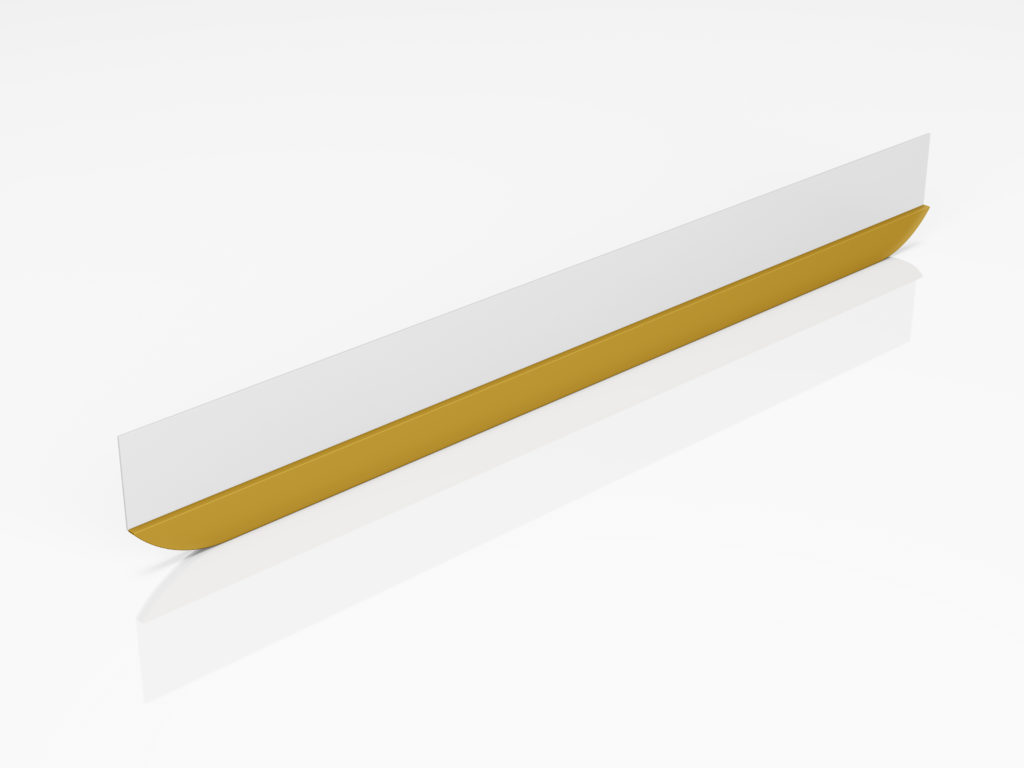
Thus a squeegee that fits onto every Rotary Screen Print Head
Moreover, no Rotary Screen Print Head is the same. It is for that reason that RKS RS WP can be made fit to use for the most popular Rotary Screen Print Head.
Most importantly is to standardize your Rotary Screen Printing Process accordingly
Specifically, the advanced RKS RS rotary screen blades support standardization of Rotary Screen printing. This is true nonetheless the speed or design of your print job.
As a result of our research and development, and working closely with Rotary Screen Print Head OEM, we created a squeegee that complements the required specific parameters settings. Therefore we will meet the quality demands of high end printing requirements.
A squeegee can only be defined as RKS RS WP rotary blade when it is made from the very best glass fibre support. Additionally the usage of irremovable highly resistant Vulkolan ® for this product type
In conclusion, the RKS RS squeegee gives you improved printing results. Furthermore, reduces your print down time and are more economical in use.
Finally, let us help you to find the right specifications for your Rotary Screen Printing Head
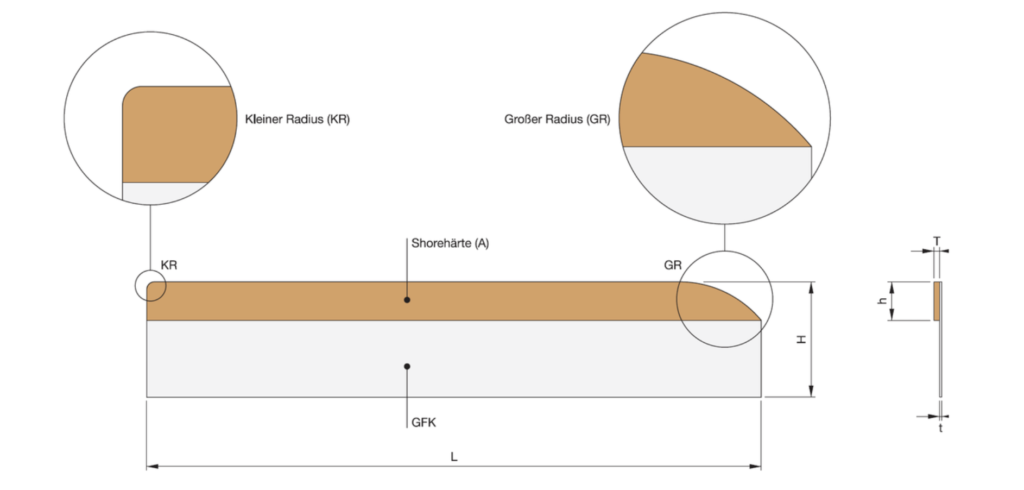
| Dimension | Specification |
| Blade Height (H) | Optional up to 50 mm high |
| Blade Length (L) | Optional up to 2,800 mm long |
| Shore Hardness (A) | 55 Shore 65 Shore 75 Shore 80 Shore |
| Radius | Optional KR (small radius) GR (large radius) |
| VU Strength (T) | 1.5 mm (thickness) 3.0 mm (thickness) |
| VU Height (h) | ca. 13.8 mm Support thickness (t) ca. 0,8 mm GFK |
- besides highly flexible, also stabilized double component blade
- both print edge (VU) insolubly bonded to carrier, as well as excellent surface characteristics
- defined plain parallel surface, as well as ground print side, and edge
- RKS RS blades are immediately ready to print
- most important higher printing speed (up to 15%)
- excellent print quality of high deposit, solid, as well as fine print
- significantly longer lifetime of both screens and squeegees (in contrast to stainless steel)
- outstanding material qualities and stability
- increased print efficiency as well as print qualty
- cost savings through both lower blade consumption as well as reduced screen damage
- reduction of maintenance, and therefore realization of cost savings
| High ink deposit (f.e. Braile) | (T) = 3.0 mm / (A) = 55 Shore (DIN A) |
| Conventional Print (Solid) | (T) = 2.0 mm / (A) = 65 Shore (DIN A) |
| Fine line and text | (T) = 1.5 mm / (A) = 80 Shore (DIN A) |
As an illustration
When you want to order 10 pieces of RKS RS Rotary blades, with a height of 35 mm, with 1.5 mm VU Thickness, length of 365 mm, Shore hardness of 75 and a large radius
Then Your order line
10 x RKS RS 35/1.5/75 LG 365 mm GR